
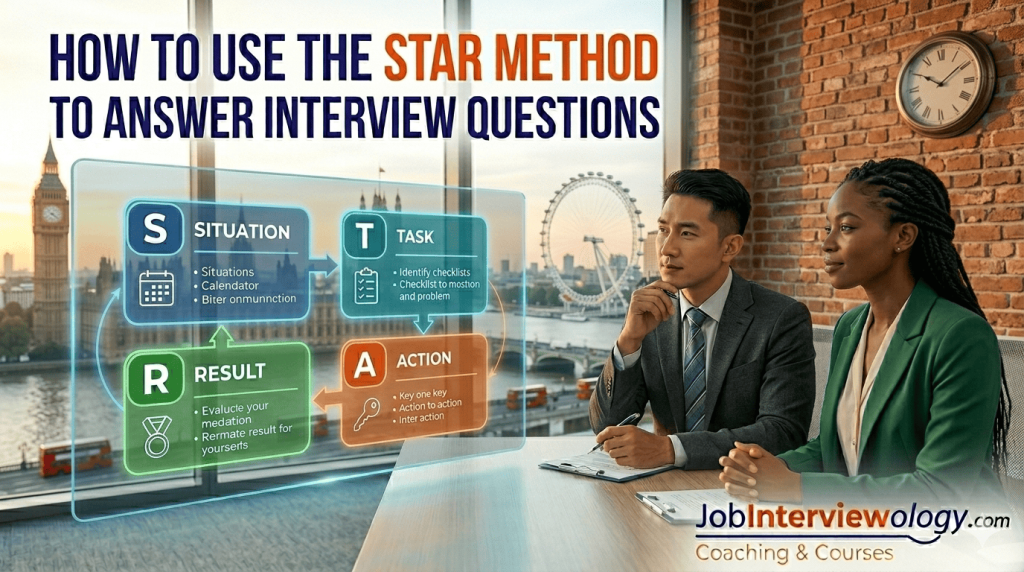
How to Use the STAR Method to Answer Interview Questions
Many candidates struggle during interviews not because they lack experience, but because they fail to communicate their experience clearly. Even highly qualified professionals can perform poorly when their answers are disorganised, vague, or difficult to follow.
Interviewers are not simply listening for “good” answers. They are evaluating how effectively you explain your experiences, how credible your examples sound, and how confidently you present yourself during the interview.
This is why structured answering techniques like the STAR method are so effective.
The STAR method helps candidates organise responses logically, making answers easier for interviewers to assess positively. Instead of rambling or jumping between points, candidates present clear examples that demonstrate skills, judgement, and results.
Many candidates improve their performance significantly through interview coaching because it helps them understand not just what to say, but how interviews are actually evaluated.
Why Many Candidates Struggle With Interview Answers
One of the biggest interview mistakes is assuming that experience alone is enough.
In reality, interviews are assessment exercises. Interviewers must quickly evaluate whether they trust a candidate to perform successfully in the role.
When answers lack structure, interviewers may struggle to identify:
- Your specific contribution
- Your decision-making process
- Your communication ability
- The impact of your actions
- Your overall professionalism
This often leads to weaker interview performance, even when the candidate has strong experience.
The problem is usually not capability. It is presentation.
Structured answering methods solve this problem by making responses easier to evaluate clearly and positively.
How Interviewers Assess Candidates
Interviewers assess candidates across several areas during an interview. They are not only interested in technical knowledge or qualifications.
According to The Interview Evaluation Model, interviewers primarily evaluate candidates across three key areas:
Communication
Communication refers to how clearly and effectively you explain your answers.
Interviewers assess:
- Structure and organisation
- Clarity of explanation
- Conciseness
- Confidence in delivery
- Ability to stay focused
Candidates who communicate clearly are easier to understand and evaluate.
Credibility
Credibility is based on how believable and convincing your examples are.
Interviewers look for:
- Real experiences
- Specific examples
- Evidence of impact
- Ownership of actions
- Logical explanations
Vague or generic answers weaken credibility because they provide little evidence of actual ability.
Perception
Perception relates to how the interviewer feels about you overall.
This includes:
- Confidence
- Professionalism
- Composure
- Enthusiasm
- Authenticity
Strong interview performance depends heavily on communication, credibility, and perception working together effectively.
The STAR method is valuable because it directly improves all three areas of the Interview Evaluation Model.
What Is the STAR Method?
The STAR method is a structured technique used to answer behavioural interview questions.
STAR stands for:
- Situation – Describe the context or background
- Task – Explain your responsibility
- Action – Describe what you did
- Result – Share the outcome
This framework helps candidates deliver answers in a logical sequence that interviewers can follow easily.
Behavioural questions often begin with phrases such as:
- “Tell me about a time when…”
- “Give an example of…”
- “Describe a situation where…”
The STAR method helps transform unclear experiences into structured, convincing answers.
Why Interviewers Prefer STAR-Based Answers
Interviewers prefer structured answers because they are easier to assess.
The STAR method improves communication by organising information clearly. It strengthens credibility by focusing on real examples and measurable outcomes. It also improves perception because structured candidates often appear more confident and professional.
Without structure, answers often become:
- Too long
- Unfocused
- Confusing
- Repetitive
- Difficult to evaluate
Candidates with strong communication skills usually perform better because interviewers can clearly understand their value.
This is why structured preparation through professional interview coaching is often highly effective for improving interview performance.
Breaking Down Each Step of the STAR Method
Situation: Set the Context Clearly
Begin by explaining the situation briefly and clearly.
The goal is to provide enough background for the interviewer to understand the scenario without wasting time on unnecessary detail.
Good situations are:
- Specific
- Relevant
- Concise
- Easy to understand
Weak communication often starts here when candidates over-explain background information.
Task: Explain Your Responsibility
Next, explain what your responsibility was within the situation.
This section demonstrates ownership and accountability.
Be clear about:
- Your role
- Your objective
- What was expected from you
- The challenge involved
Strong credibility comes from clearly explaining your contribution rather than speaking only about the team generally.
Action: Describe What You Did
This is the most important part of the answer.
Interviewers want to understand:
- Your thought process
- Your decision-making
- Your communication skills
- Your problem-solving ability
Focus specifically on your actions.
Avoid:
- Speaking only about “we”
- Giving vague explanations
- Skipping key decisions
- Rushing through important details
Candidates preparing for high-level interviews often improve this area through competency-based interview coaching, where structured behavioural answers are heavily practised.
Result: Show the Outcome
Always finish with a clear result.
Strong results include:
- Measurable outcomes
- Positive impact
- Lessons learned
- Business improvements
- Successful resolutions
The result strengthens credibility because it proves your actions created value.
Many candidates weaken otherwise good answers by forgetting to explain the outcome clearly.
Example of a STAR Method Answer
Question:
Tell me about a time you handled a difficult client.
Situation:
I was managing a project where a client became frustrated due to delays in delivery timelines.
Task:
My responsibility was to rebuild trust with the client while ensuring the project remained achievable for the internal team.
Action:
I organised a meeting to understand the client’s concerns, reviewed the project schedule with the team, and created a revised timeline with more frequent progress updates.
Result:
The client appreciated the transparency, the relationship improved significantly, and the project was completed successfully within the revised schedule.
This structure improves communication, strengthens credibility, and creates a more positive perception overall.
When to Use the STAR Method in Interviews
The STAR method is most effective for behavioural and competency-based interview questions.
Common examples include:
- Managing conflict
- Working under pressure
- Solving problems
- Leading a team
- Handling difficult stakeholders
- Managing deadlines
- Dealing with failure
It is widely used across industries, including corporate, public sector, healthcare, and technology recruitment.
Candidates preparing for specialist interview processes may also benefit from:
- Civil Service Interview Coaching
- NHS Interview Coaching
- Google Interview Coaching
- Amazon Interview Coaching
- FAANG Interview Coaching
Each of these interview environments places strong emphasis on structured behavioural responses.
Common Mistakes When Using the STAR Method
Spending Too Long on the Situation
Many candidates spend too much time explaining background information.
This weakens communication because interviewers lose focus before reaching the important parts of the answer.
The situation should provide context, not dominate the response.
Focusing Too Much on the Team
Interviewers need to understand your individual contribution.
Using “we” excessively can reduce credibility because it becomes unclear what you personally achieved.
Focus on:
- Your actions
- Your decisions
- Your communication
- Your contribution
Skipping the Result
Some candidates explain actions but never describe the outcome.
Without results, interviewers cannot properly evaluate effectiveness.
Always explain:
- What happened
- What improved
- What was achieved
- What you learned
Sounding Over-Rehearsed
Preparation is important, but memorised answers can sound robotic.
Interviewers generally respond better to candidates who sound natural, conversational, and confident.
The goal is structured communication, not scripted delivery.
How to Practise the STAR Method Effectively
The best way to improve STAR answers is through repeated structured practice.
Start by listing experiences related to:
- Leadership
- Problem-solving
- Teamwork
- Conflict resolution
- Pressure situations
- Achievements
Then structure each example using:
- Situation
- Task
- Action
- Result
Practising aloud improves communication clarity and confidence significantly.
Graduates and early-career professionals often benefit from graduate interview coaching because it helps build structured communication skills early.
Adapting the STAR Method for Virtual Interviews
Virtual interviews require even clearer communication because screen-based conversations can make interaction more difficult.
To improve STAR answers in virtual interviews:
- Speak at a steady pace
- Pause briefly between sections
- Maintain eye contact with the camera
- Avoid rushing
- Keep answers structured and concise
Clear communication improves interviewer perception significantly during online interviews.
Candidates preparing for assessment centres and online recruitment stages may also benefit from presentation and group interview coaching.
Why Structured Preparation Matters
Structured preparation helps candidates become easier to evaluate positively.
Well-prepared candidates usually:
- Communicate more clearly
- Present stronger examples
- Sound more confident
- Stay focused under pressure
- Create stronger overall perception
The Interview Evaluation Model explains that interview success depends heavily on making assessment easier for the interviewer.
The STAR method directly supports this process by improving communication, credibility, and perception simultaneously.
Final Thoughts
The STAR method is one of the most effective techniques for answering behavioural interview questions because it creates structure, clarity, and credibility.
Interviewers are constantly evaluating candidates based on:
- Communication
- Credibility
- Perception
Candidates who understand The Interview Evaluation Model often perform more effectively because they understand how interviews are actually assessed.
By using the STAR method consistently, practising structured communication, and focusing on real examples, you can significantly improve your interview performance and increase your chances of success.
FAQs
1. What is the STAR method in interviews?
The STAR method is a structured technique for answering behavioural interview questions using Situation, Task, Action, and Result. It helps candidates communicate experiences clearly and logically.
2. Why do interviewers prefer STAR answers?
Interviewers prefer STAR answers because they are easier to evaluate. Structured answers improve communication, strengthen credibility, and help interviewers understand your experience more clearly.
3. How long should a STAR answer be?
Most STAR answers should last around one to two minutes. The answer should remain concise while still including all four sections clearly.
4. Can I use the STAR method for all interview questions?
The STAR method works best for behavioural and competency-based questions. Technical or direct factual questions may require shorter and simpler responses.
5. What mistakes should I avoid when using the STAR method?
Common mistakes include giving too much background information, skipping the result, speaking too vaguely, or focusing too heavily on the team instead of your own actions.
6. How can I make my STAR answers stronger?
Focus on specific actions, measurable outcomes, and clear communication. Strong examples with real results improve both credibility and perception.
7. Is it okay to prepare STAR answers before the interview?
Yes. Preparing STAR examples in advance improves confidence and clarity. However, your delivery should still sound natural rather than memorised.
8. Does the STAR method improve interview performance?
Yes. The STAR method improves answer structure, communication, and confidence, making it easier for interviewers to assess candidates positively.