
NHS Interview Questions and Answers: Values, Competency & Panel
Preparing for an NHS interview requires more than reviewing your qualifications. NHS employers assess whether candidates demonstrate the values, behaviours, communication skills, and competencies needed to deliver high-quality patient care and work effectively within healthcare teams.
Whether you’re applying for a nursing, healthcare assistant, administrative, support, allied health professional, management, or leadership role, understanding the NHS interview process can significantly improve your chances of success.
NHS interviews commonly include:
- Values-based interview questions
- Competency-based interview questions
- Scenario-based interview questions
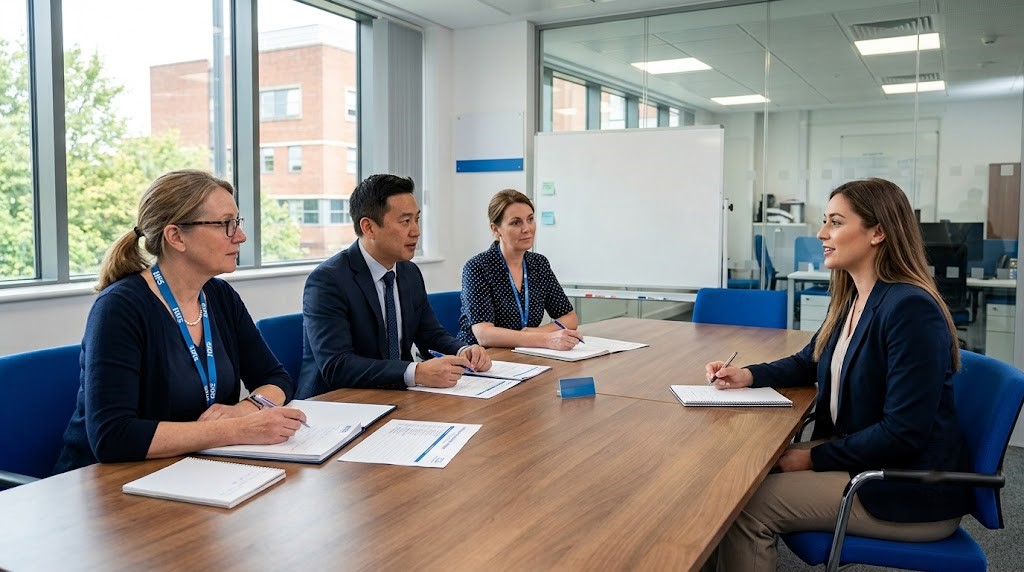
- Panel interview questions
Many candidates focus solely on preparing answers. Strong candidates also understand how NHS interview panels assess those answers.
In this guide, you’ll find common NHS interview questions and answers, practical preparation strategies, and expert insights into how NHS interviewers evaluate candidates.
How NHS Interviewers Assess Candidates
- One of the biggest mistakes NHS candidates make is assuming interviewers are simply looking for the “right answer”.
In reality, NHS interviews are structured assessment exercises designed to evaluate whether candidates demonstrate the communication skills, behaviours, judgement, professionalism, and NHS values required for the role.
At Job Interviewology, this is explained through the Interview Evaluation Model, which breaks interview performance into three core areas:
Assessment Area | What NHS Interviewers Evaluate |
Communication | How clearly, logically, and professionally you explain your answers |
Credibility | Whether your examples are specific, evidence-based, believable, and relevant |
Perception | The overall impression created through confidence, professionalism, empathy, and attitude |
Strong NHS candidates make it easy for interviewers to assess their suitability.
Throughout the interview process, communication, credibility, and perception all influence how answers are evaluated.
This is why two candidates with very similar qualifications and experience can receive very different interview outcomes.
Many candidates use NHS Interview Coaching to understand how interviewers assess answers and how to present their experience more effectively.
What Are the Most Common NHS Interview Questions?
The most common NHS interview questions focus on:
- NHS values and patient care
- Teamwork and collaboration
- Communication skills
- Problem-solving
- Working under pressure
- Handling difficult situations
- Conflict resolution
- Patient safety
- Leadership and accountability
- Motivation for joining the NHS
Although the exact questions vary between roles and NHS Trusts, most interviews assess similar themes.
Types of NHS Interview Questions
Interview Type | What Interviewers Assess | Example Question |
Values-Based Questions | Alignment with NHS values and behaviours | Why do you want to work for the NHS? |
Competency-Based Questions | Previous performance and workplace skills | Tell us about a time you solved a problem |
Scenario-Based Questions | Judgement and decision-making | What would you do if a patient became upset? |
Panel Interview Questions | Communication and confidence | How do you manage competing priorities? |
Behavioural Questions | Previous experiences and actions | Describe a time you worked under pressure |
Understanding which type of question is being asked allows you to structure stronger answers and provide more relevant evidence.
Common NHS Interview Themes by Band
Although every NHS role is different, interview panels often focus on slightly different competencies depending on the band level.
NHS Band | Common Assessment Areas |
Band 2–4 | Communication, teamwork, reliability, patient care, professionalism |
Band 5 | Clinical judgement, prioritisation, patient-centred care, resilience |
Band 6 | Leadership, mentoring, decision-making, service improvement |
Band 7 | Team management, stakeholder engagement, strategic thinking |
Band 8–9 | Organisational leadership, transformation, governance, influencing |
Understanding what your panel is likely to assess helps you prepare stronger examples and more relevant answers.
Understanding NHS Values-Based Interview Questions
Values-based recruitment plays a central role in NHS hiring.
NHS employers want to ensure candidates demonstrate behaviours and attitudes that align with the NHS Constitution and support excellent patient care.
Interviewers are often assessing:
- Compassion
- Respect and dignity
- Teamwork
- Commitment to quality care
- Professionalism
- Continuous improvement
Strong answers combine personal values with real examples that demonstrate those values in practice.
Why Do You Want to Work for the NHS?
Example Answer
I want to work for the NHS because it provides an opportunity to make a positive impact on people’s lives every day. I admire the NHS commitment to delivering high-quality care to everyone regardless of background and believe my skills, values, and work ethic align closely with that mission. Working in an environment focused on helping others would be both professionally rewarding and personally meaningful.
What Does Compassion Mean to You?
Example Answer
Compassion means treating people with kindness, empathy, and understanding, particularly when they are facing difficult situations. It involves listening carefully, respecting individual needs, and taking appropriate action to provide support. Compassion helps build trust and improves the overall experience for patients, families, and colleagues.
How Would You Demonstrate Respect in the Workplace?
Example Answer
I demonstrate respect by treating everyone fairly, listening to different viewpoints, and maintaining professionalism in all interactions. Respect also means valuing diversity and ensuring colleagues and patients feel heard, supported, and appreciated regardless of their background or circumstances.
NHS Competency-Based Interview Questions
Competency-based questions focus on your previous experiences and how you have handled workplace situations.
These questions often begin with phrases such as:
- Tell us about a time when…
- Describe a situation where…
- Give an example of…
- Tell us about a challenge you faced…
The NHS commonly uses competency-based interviewing because past behaviour is often a strong indicator of future performance.
Preparing examples using the STAR method can help you answer these questions effectively.
The STAR framework also supports the Interview Evaluation Model by improving communication, strengthening credibility through evidence-based examples, and helping candidates create a positive impression during NHS interviews.
Why the STAR Method Works So Well in NHS Interviews
Many NHS candidates learn the STAR method but do not fully understand why it is so effective.
The STAR framework aligns closely with the Interview Evaluation Model because it improves all three areas that interviewers assess.
STAR Benefit | Interview Evaluation Model Impact |
Creates clear answer structure | Improves Communication |
Uses evidence-based examples | Strengthens Credibility |
Helps candidates sound organised and confident | Improves Perception |
This is why STAR-based answers are commonly used across NHS interviews, Civil Service interviews, and other competency-based recruitment processes.
Candidates who struggle to structure examples often benefit from Competency-Based Interview Coaching.
Tell Us About a Time You Worked as Part of a Team
Example Answer
In a previous role, our department experienced staff shortages during a particularly busy period. I worked closely with colleagues to prioritise workloads and ensure important tasks were completed on time. By communicating regularly and supporting team members where needed, we maintained service standards and successfully met our objectives.
Describe a Situation Where You Solved a Problem
Example Answer
I noticed recurring delays caused by inconsistent communication between departments. I suggested a clearer process for sharing updates and worked with colleagues to implement it. This reduced misunderstandings, improved efficiency, and helped the team complete tasks more effectively.
Tell Us About a Time You Worked Under Pressure
Example Answer
During a particularly busy period, I had multiple urgent tasks with competing deadlines. I created a clear priority list, communicated with stakeholders, and focused on completing high-priority work first. As a result, all responsibilities were completed accurately and on time.
NHS Interview Preparation Checklist
Task | Recommended Action |
Research NHS Values | Review the NHS Constitution and core values |
Study the Job Description | Understand responsibilities and required skills |
Prepare STAR Examples | Create examples for teamwork, communication, and problem-solving |
Practise Common Questions | Rehearse answers aloud before the interview |
Prepare Questions to Ask | Show genuine interest in the role |
Review Professional Conduct | Understand patient-centred care expectations |
A structured approach to preparation helps candidates improve communication, strengthen credibility, and create a stronger overall impression during NHS interviews.
NHS Scenario-Based Interview Questions
Scenario-based questions assess how you would respond in realistic workplace situations. NHS interview panels use these questions to evaluate judgement, professionalism, patient-centred care, communication, and decision-making.
Unlike competency questions, which focus on past experiences, scenario questions focus on how you would handle future situations.
Strong answers should demonstrate:
- Patient safety
- Professional judgement
- Communication skills
- NHS values
- Appropriate escalation when required
What Would You Do if a Patient Became Upset?
Example Answer
I would remain calm and listen carefully to the patient’s concerns without interrupting. I would acknowledge their feelings and show empathy while trying to understand the cause of the issue. Once I understood the situation, I would explain what actions could be taken to help resolve the problem. If necessary, I would seek support from a senior colleague or follow the appropriate NHS procedures to ensure the patient received the support they needed.
What Would You Do if You Witnessed Poor Practice?
Example Answer
Patient safety must always come first. If I witnessed poor practice, I would follow NHS procedures by documenting my concerns and reporting them through the appropriate channels. I would remain professional throughout the process and focus on ensuring patient safety rather than making assumptions. Raising concerns appropriately helps maintain standards and protects both patients and staff.
How Would You Handle a Conflict With a Colleague?
Example Answer
I would approach the situation professionally and arrange a private discussion to understand their perspective. I would focus on the facts rather than emotions and work collaboratively to find a solution. If the issue could not be resolved informally, I would follow organisational procedures and seek guidance from an appropriate manager. Maintaining professional relationships is important for effective teamwork and patient care.
What Would You Do if You Made a Mistake?
Example Answer
If I made a mistake, I would take responsibility immediately and ensure any potential risk to patient safety was addressed. I would inform the appropriate person, follow reporting procedures, and reflect on what happened to prevent a recurrence. Being honest and accountable is essential in healthcare environments.
NHS Panel Interview Tips
Many NHS interviews are conducted by panels rather than a single interviewer. This allows employers to assess candidates from multiple perspectives and reduces individual bias in the selection process.
Panel interviews can feel more intimidating, but understanding what interviewers are assessing can significantly improve performance.
Engage With the Entire Panel
Make eye contact with all interviewers during your answers rather than focusing on a single individual.
This demonstrates confidence, professionalism, and strong communication skills.
Take Time Before Answering
Many candidates rush their answers because they feel under pressure.
It is perfectly acceptable to pause briefly before responding.
A structured answer delivered calmly is usually far more effective than an immediate but disorganised response.
Use Real Examples
NHS interviewers value evidence-based answers.
Whenever possible, support your responses with examples from:
- Previous employment
- Clinical placements
- Volunteering
- University projects
- Training programmes
- Personal experiences where relevant
Real examples improve credibility and make answers easier to assess.
Structure Your Answers Clearly
One of the easiest ways to improve interview performance is to make answers easier to follow.
Structured answers improve:
- Communication
- Credibility
- Perception
which directly supports stronger interview performance.
Many candidates use Interview Coaching sessions to practise answering panel questions confidently and improve their overall interview technique.
Why Candidates Fail NHS Interviews
Many NHS candidates assume they failed because they lacked experience or qualifications.
In reality, most interview failures occur because candidates make it difficult for interviewers to assess them positively.
This usually falls into one of three areas identified by the Interview Evaluation Model.
Poor Communication
Examples include:
- Rambling answers
- Unclear explanations
- Poor answer structure
- Talking around the question
- Failing to answer directly
Even strong experience can appear weaker when communication lacks clarity.
Interviewers can only assess what they understand.
Weak Credibility
Examples include:
- Vague examples
- Generic statements
- Lack of evidence
- No measurable outcomes
- Overuse of theoretical answers
Strong candidates support their claims with specific examples and outcomes.
Credibility increases when interviewers can clearly see what you personally contributed.
Negative Perception
Examples include:
- Low confidence
- Poor body language
- Defensive responses
- Lack of enthusiasm
- Unprofessional communication
Perception influences hiring decisions because NHS employers want candidates who inspire confidence and will represent the organisation professionally.
Common NHS Interview Mistakes to Avoid
Many NHS candidates struggle in interviews not because they lack the necessary skills or experience, but because they make it difficult for interviewers to assess them effectively.
Understanding the most common mistakes can help you avoid them and improve your overall performance.
Poor Communication
Answers that are too long, disorganised, or unclear make it difficult for interviewers to identify relevant evidence.
Common communication mistakes include:
- Rambling answers
- Poor structure
- Not answering the question directly
- Speaking too quickly due to nerves
- Using excessive jargon without explanation
Clear communication improves interviewer understanding and strengthens your overall performance.
Weak Credibility
Candidates often make broad claims without supporting them with evidence.
Examples include:
- Claiming to be a strong team player without providing examples
- Stating leadership ability without demonstrating impact
- Discussing patient care without evidence of experience
Strong NHS interview answers contain specific examples, clear actions, and measurable outcomes wherever possible.
Negative Perception
Confidence, professionalism, and attitude all influence how candidates are perceived.
Examples that can create a negative impression include:
- Arriving unprepared
- Poor body language
- Lack of enthusiasm
- Defensive responses
- Speaking negatively about previous employers
A positive perception often increases interviewer confidence in your suitability for the role.
NHS Interview Success Checklist
Before your NHS interview, ensure you have completed the following:
Preparation Area | Why It Matters |
Research NHS Values | Demonstrates alignment with the NHS Constitution |
Review the Job Description | Helps identify likely competencies and behaviours |
Prepare STAR Examples | Improves structure and answer quality |
Research the NHS Trust | Demonstrates genuine interest and preparation |
Practise Answers Aloud | Improves confidence and communication |
Prepare Questions for the Panel | Demonstrates engagement and professionalism |
Review Clinical or Role-Specific Topics | Improves confidence in technical discussions |
Plan Interview Logistics | Reduces stress and avoids last-minute issues |
Candidates who prepare systematically are often easier for interviewers to assess positively.
Why Structured Preparation Matters
Successful NHS candidates understand that interviews are not simply about answering questions.
They are about making it easy for interviewers to evaluate your suitability for the role.
Effective preparation focuses on:
- Clear communication
- Strong evidence and examples
- Understanding NHS values
- Structured answer delivery
- Professional presentation
- Confidence under pressure
These principles align directly with the Interview Evaluation Model and help candidates perform more consistently during NHS interviews.
Structured preparation improves:
- Communication
- Credibility
- Perception
which are the three factors that most strongly influence interview outcomes.
Why Choose Job Interviewology
Preparing for an NHS interview requires more than memorising answers.
Candidates need to understand values-based recruitment, competency questioning, scenario-based assessments, and panel interview techniques.
Job Interviewology helps candidates develop structured responses that reflect both their experience and their alignment with NHS values.
Our coaching focuses on:
- Improving communication and answer structure
- Building stronger evidence-based examples
- Developing confidence under pressure
- Understanding how NHS interview panels assess candidates
- Preparing for Band 2 to Band 9 interviews
- Tailoring answers to NHS Trust expectations
The goal is not simply to help candidates answer questions. It is to help them present their experience in a way that is easy for interviewers to evaluate positively.
How Job Interviewology Helps NHS Candidates
Many NHS applicants have the right skills and experience but struggle to communicate them effectively during interviews.
Our coaching helps candidates:
- Improve answer structure using proven frameworks
- Strengthen STAR examples
- Develop confidence and clarity
- Prepare for panel interviews
- Handle difficult competency and scenario questions
- Understand NHS values-based recruitment
Candidates often find that personalised feedback highlights weaknesses they were previously unaware of and helps them improve more quickly.
For those seeking additional support, our NHS Interview Coaching, Competency-Based Interview Coaching, and Professional Interview Coaching services provide tailored preparation based on your role, NHS band, and interview requirements.
Bottom Line
NHS interviews assess far more than qualifications and technical knowledge.
Recruiters evaluate how effectively candidates demonstrate:
- Communication
- Teamwork
- Compassion
- Professionalism
- Decision-making
- Commitment to patient care
Successful candidates understand not only the questions being asked, but also how their answers are being evaluated.
Through the Interview Evaluation Model, candidates can focus on improving Communication, Credibility, and Perception throughout the interview process.
By preparing structured examples, understanding NHS values, and practising realistic interview scenarios, candidates can significantly improve their confidence and overall interview performance.
Frequently Asked Questions
1. What questions are commonly asked in NHS interviews?
NHS interviews typically include values-based, competency-based, behavioural, and scenario-based questions. Employers often assess teamwork, communication, patient care, problem-solving, professionalism, and the ability to work under pressure.
2. What is a values-based NHS interview?
A values-based interview assesses whether your behaviours and attitudes align with NHS values such as compassion, respect, teamwork, dignity, and commitment to quality care.
3. How should I prepare for an NHS panel interview?
Research NHS values, review the job description, prepare STAR examples, practise common questions, and familiarise yourself with the Trust’s priorities and values.
4. What is the STAR method in NHS interviews?
STAR stands for Situation, Task, Action, and Result. It helps candidates provide structured and evidence-based answers to competency questions.
5. Do NHS interviews include scenario-based questions?
Yes. Scenario questions are commonly used to assess judgement, professionalism, communication, patient-centred care, and decision-making in realistic workplace situations.
6. What should I wear to an NHS interview?
Professional business attire is generally recommended. A smart and professional appearance helps create a positive first impression and demonstrates respect for the interview process.
7. How can I improve my NHS interview confidence?
Confidence improves through preparation, mock interviews, structured answer practice, and understanding how NHS interview panels assess candidates.
8. How can NHS interview coaching help?
NHS interview coaching helps candidates improve answer structure, communication, confidence, and understanding of NHS interview expectations. Personalised feedback can help identify weaknesses and improve performance more quickly than self-study alone.